Extreme Points Algorithm
Slides covered: 202–205
Topic folder: 03 Convex Hulls
Fast take
- A point is non-extreme if it lies inside some triangle formed by other points.
- So a brute-force hull algorithm can test each point against many triangles.
- The method is correct but far too slow to be a serious general solution.
- Its real value is conceptual: it explains what makes a hull vertex special.
Recording notes
Recording references: CS 564 - 02.20 9.2.txt
- The lecture used this algorithm mainly as a foil for better ones, not as something you should admire.
- It makes the definition of “extreme” concrete, which is why it shows up before Graham scan.
- If you are still checking huge numbers of triangles, the algorithm has already lost the asymptotic war.
- This is the baseline that motivates every smarter hull method afterward.
Motivation
The extreme points algorithm is the straightforward idea: a point is a hull vertex if it is not inside any triangle formed by the others. It is conceptually simple and computationally painful, which sounds exactly like the kind of algorithm humans invent first.
Lecture Roadmap
- Know the problem definition.
- Know the main geometric idea.
- Know the key data structure or primitive test.
- Know the preprocessing / query / storage or total running time.
- Know one small example by hand.
Detailed lecture notes
Slide 202: Extreme points and hull outline
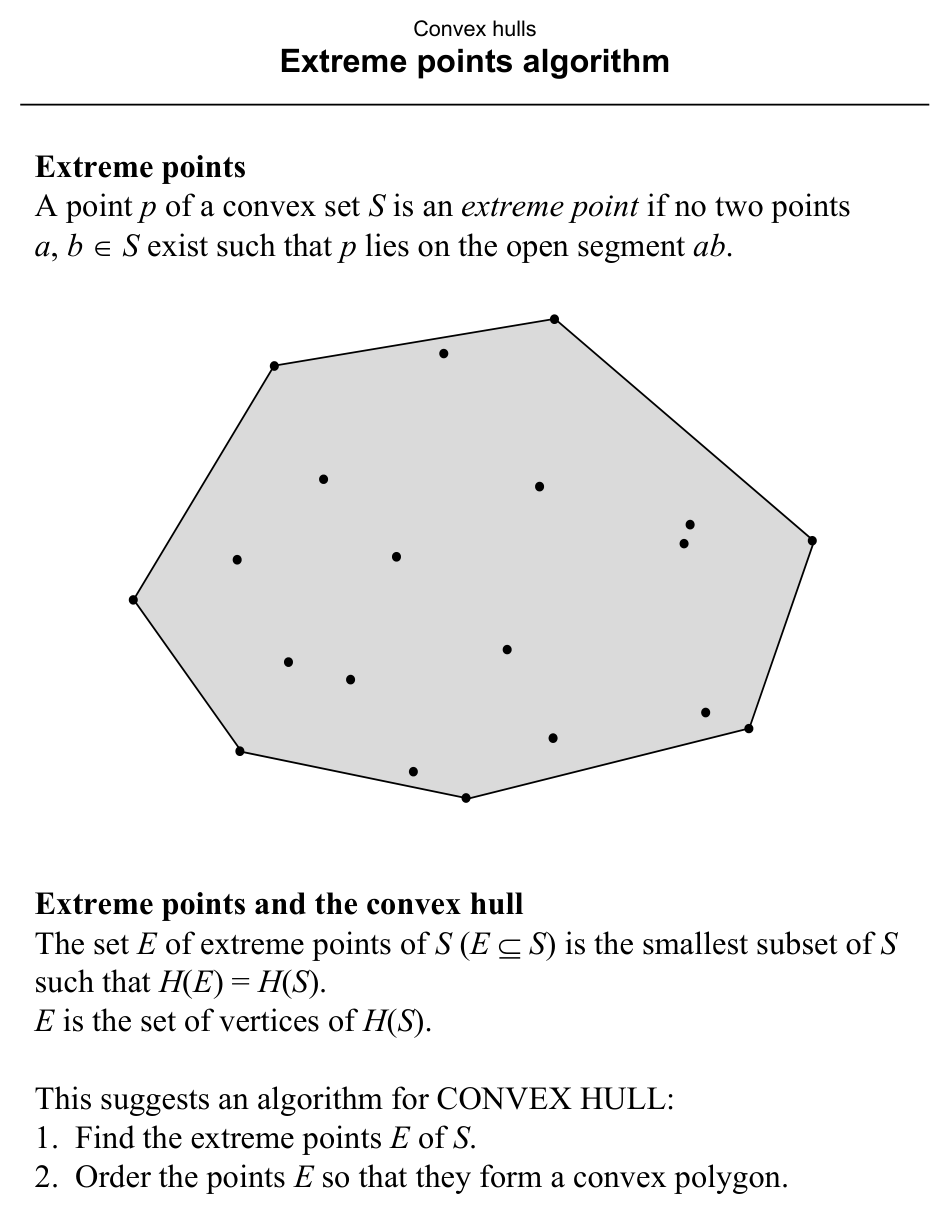
A point \(p\) of a convex set \(S\) is an extreme point if there do not exist \(a,b \in S\) with \(p\) strictly between \(a\) and \(b\) on segment \(\overline{ab}\).
Let \(E \subseteq S\) be the set of extreme points. Then \(E\) is the smallest subset with \(H(E) = H(S)\); equivalently \(E\) is the vertex set of \(H(S)\).
Two-step hull algorithm:
- Find the extreme points \(E\).
- Order \(E\) cyclically around the hull to form a convex polygon.
Slide 203: Characterization for the plane
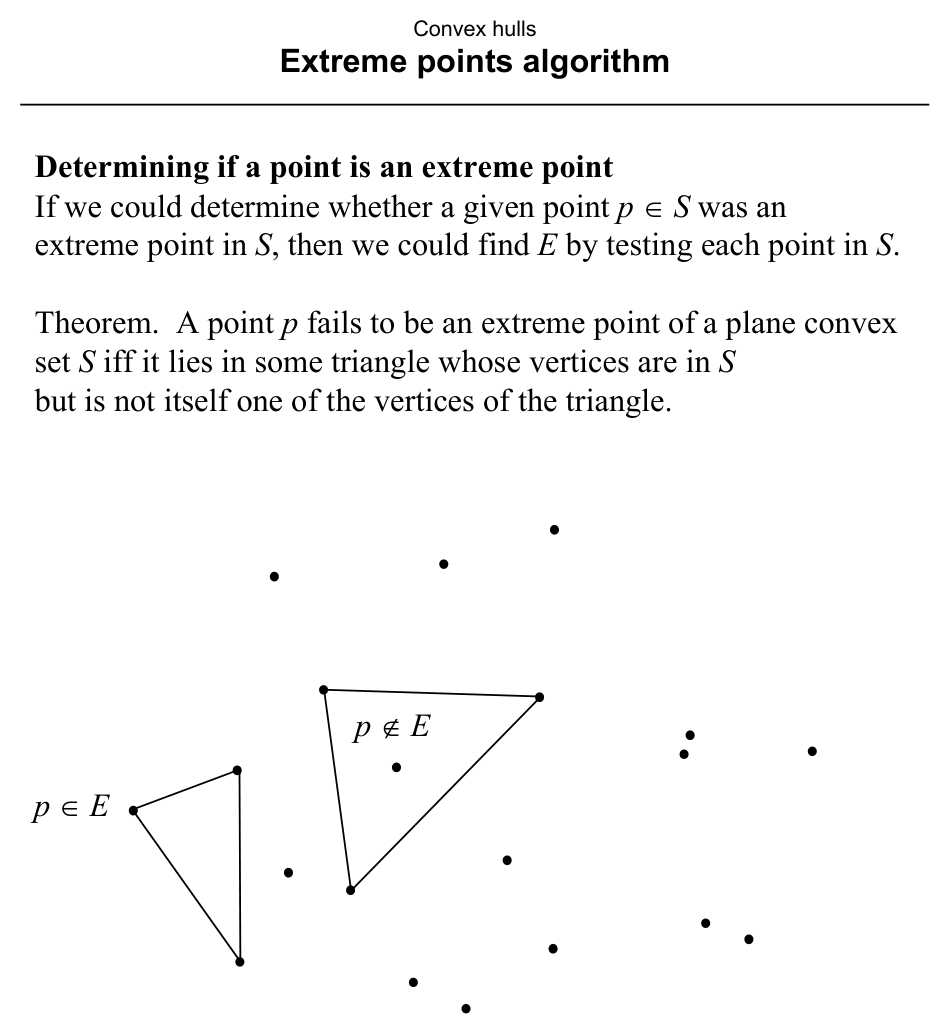
Theorem: A point \(p \in S\) fails to be extreme iff \(p\) lies inside (or on) some triangle whose vertices are three points of \(S\), and \(p\) is not one of those three vertices.
Slide 204: Naive extreme-point test
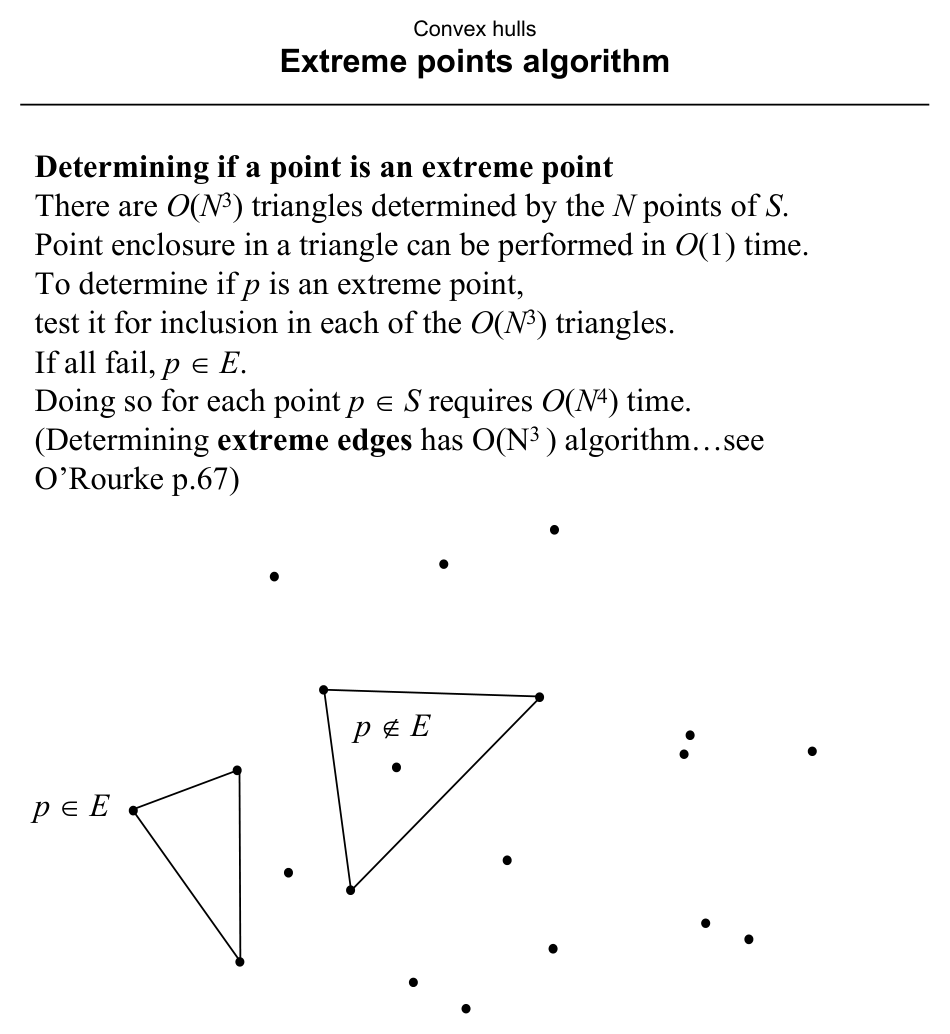
There are \(\binom{N}{3} = O(N^3)\) triangles determined by \(S\). Point-in-triangle tests are \(O(1)\) each.
To test one point \(p\): try all \(O(N^3)\) triangles; if \(p\) lies in none (as a non-vertex), then \(p \in E\).
Repeating for all \(p \in S\): \(O(N^4)\) time.
(Alternative \(O(N^3)\) approaches for related edge tests appear in O’Rourke, p. 67.)
Slide 205: Ordering \(E\)
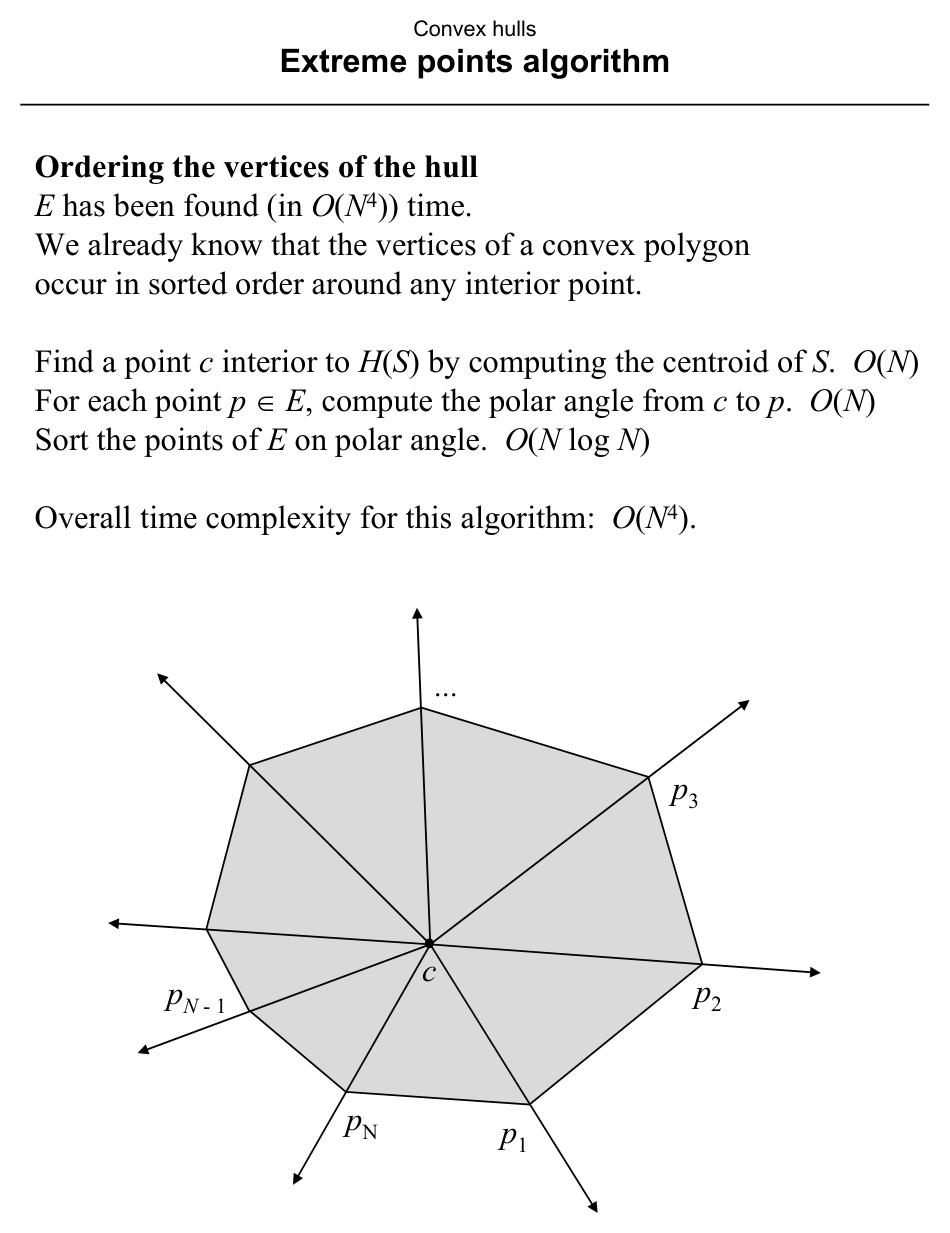
After finding \(E\) in \(O(N^4)\):
- Pick an interior point \(c\) (e.g. centroid of \(S\)) — \(O(N)\).
- For each \(p \in E\), compute polar angle from \(c\) to \(p\) — \(O(|E|)\).
- Sort \(E\) by polar angle — \(O(|E| \log |E|)\).
Overall: \(O(N^4)\) dominated by the extreme-point phase.
Recap
- A point is extreme iff it is not strictly inside a segment between two other points of \(S\); the extreme set \(E\) is the vertex set of \(H(S)\).
- Test: \(p\) is non-extreme iff \(p\) lies in some triangle determined by three other points of \(S\) — \(O(N^3)\) triangles, \(O(1)\) test each → \(O(N^4)\) naively for all points.
- After finding \(E\), sort by polar angle about an interior point (e.g. centroid) in \(O(|E|\log |E|)\) to produce a polygon boundary; total remains \(O(N^4)\).